CALGARY REAL ESTATE BLOG

RSS

Clean Your Gutters Before Winter: Protect Your Calgary Home From Snowmelt and Foundation Damage

As Calgary homeowners prepare for winter, cleaning the gutters and checking downspouts may not be at the top of the to-do list. However, this simple maintenance task can help protect your home from water damage during winter thaws and the spring snowmelt.

Calgary's weather can change quickly. Heavy snowfall can be followed by a chinook that sends temperatures soaring, melting snow on roofs, driveways and lawns. When that water cannot drain away properly, it can collect around your home's foundation, seep into a basement or contribute to ice buildup around walkways and entrances.

Before winter arrives, clean your gutters, make sure your downspouts are connected and directing water away from the house, and check that water discharges at least six feet from your foundation. The City of Calgary recommends directing water away from building foundations and keeping drainage pathways clear to help protect homes from water damage.

Here is what every Calgary homeowner should know about preparing gutters and downspouts for winter.

Calgary Home Maintenance

Why Is It Important to Clean Your Gutters Before Winter?

Your home's eavestroughs, commonly called gutters, collect rainwater and melting snow from the roof and direct it through downspouts away from the house.

When gutters become clogged with leaves, pine needles, roof debris and other material, water may not drain properly. As temperatures drop, trapped water can freeze, creating additional blockages and potentially contributing to ice buildup.

When warmer weather returns, melting snow can overwhelm a blocked or poorly draining system.

Cleaning your gutters before winter helps:

  • Reduce the risk of water pooling near your foundation. Proper drainage directs roof runoff away from the house.

  • Reduce the chance of overflowing gutters. Clear channels allow water to move toward the downspouts.

  • Help prevent ice buildup. Removing debris reduces obstructions where water can collect and freeze.

  • Protect exterior materials. Persistent overflow can contribute to moisture damage around fascia, siding and other building components.

  • Prepare your home for spring snowmelt. Clear drainage pathways are particularly important when temperatures rise quickly after a snowfall.

Gutter cleaning does not eliminate every winter water problem, but it is an important part of routine home maintenance.

Calgary's Winter Thaws Make Proper Drainage Especially Important

Calgary's winter weather is unpredictable. Temperatures can remain well below freezing for extended periods before a chinook brings warmer conditions and rapid snowmelt.

During these warm spells, water from the roof and melting snow around the property needs somewhere to go.

The challenge is that the ground may still be frozen or saturated, limiting how quickly it can absorb water. If roof runoff is discharged beside the house, water can accumulate near the foundation instead of draining safely away.

Over time, poor drainage can contribute to basement dampness, seepage and other moisture-related problems. The actual risk depends on factors such as soil conditions, grading, foundation construction and the condition of the home's drainage systems.

This is why preparing your gutters and downspouts before freeze-up is an important step in protecting your Calgary home.

Why Your Downspouts Should Extend at Least Six Feet From Your Foundation

One of the most important parts of gutter maintenance is making sure the downspouts direct water far enough away from your home.

A downspout that ends immediately beside the foundation can release a concentrated volume of water into the soil directly next to the house. During a winter thaw, that water may pool against the foundation or flow toward areas where drainage is poor.

As a general homeowner maintenance target, extend downspouts at least six feet away from the foundation, and farther where necessary to ensure water drains away safely. The City of Calgary recommends directing water away from building foundations and identifies a minimum distance of two metres, approximately 6.6 feet, from building foundations in its homeowner guidance.

The goal is not simply to move water a few feet away. It is to direct it toward an appropriate drainage area without sending it back toward the house, onto a neighbour's property or onto public walkways where it could freeze.

What to check

  • Make sure each downspout is securely connected to the gutter.

  • Check that the lower section is attached and directing water away from the house.

  • Install a suitable extension if the downspout currently ends beside the foundation.

  • Ensure the extension does not direct water toward neighbouring properties, sidewalks or driveways.

  • Check that the ground slopes away from the foundation rather than back toward it.

  • Keep drainage swales and other designated drainage pathways clear.

A splash block or extension can help direct water, but the surrounding grading still matters. If the yard slopes toward the house, water may flow back toward the foundation even when the downspout is extended.

Calgary Home Maintenance

Why Downspouts Need to Be Connected and Properly Positioned Before Winter

It is worth walking around your home before winter to check every downspout.

Sometimes extensions are removed during yard work, become disconnected or are left positioned so close to the foundation that water drains into the same area you are trying to protect.

A disconnected or poorly positioned downspout can defeat the purpose of having a gutter system.

During a chinook, snowmelt can run off the roof in significant quantities. If the downspout is not connected or the water has nowhere appropriate to go, runoff may spill beside the house, saturate the surrounding soil or create icy areas.

Make sure your downspouts are:

  • Connected to the gutters and securely fastened.

  • Free of visible debris and obstructions.

  • Positioned to direct water away from the foundation.

  • Long enough to discharge water into an appropriate area.

  • Arranged so that runoff does not create an ice hazard on walkways or driveways.

If you use removable extensions, check that they are properly positioned before winter and remain effective during periods of snowmelt.

What Happens If Water Collects Around Your Foundation?

Water management around the foundation is an important part of maintaining a home.

When water repeatedly collects beside foundation walls, it can increase moisture exposure and contribute to basement dampness or seepage, particularly when drainage or waterproofing is already compromised.

Potential warning signs include:

  • Water pooling beside the house after a thaw.

  • Damp basement walls or floors.

  • A musty smell in the basement.

  • Water stains or signs of previous moisture intrusion.

  • Soil that has settled beside the foundation.

  • Downspouts discharging directly beside the house.

  • Ground that slopes toward the foundation.

These signs do not necessarily mean that the foundation itself is damaged. However, recurring moisture should be investigated so the source can be identified and corrected.

Keeping water away from the foundation is a sensible preventive measure, but it does not replace appropriate foundation drainage, waterproofing or repairs where those are needed.

Calgary Home Maintenance

Your Pre-Winter Gutter and Downspout Checklist

Before temperatures remain consistently below freezing, take a few minutes to inspect your home's drainage system.

Winter Home Maintenance Checklist

0 of 10

If your gutters are difficult to reach, the roof is icy or you are uncomfortable working at height, hire a qualified professional rather than climbing a ladder in unsafe conditions.

What About Spring Snowmelt in Calgary?

Spring is another important time to check your drainage system.

Even if your gutters were cleaned in the fall, additional debris may have accumulated over winter. Snow can also build up around window wells, basement entrances and the foundation.

When temperatures rise, take a walk around your property and look for areas where water is pooling. Check that downspouts are directing water away from the house and that the ground is not sloping toward the foundation.

It is also worth checking the storm drain near your property for visible snow or debris where it is safe to do so. The City of Calgary recommends keeping drainage pathways clear during winter and snowmelt periods.

Never attempt to chip away at ice covering a storm drain if doing so could be unsafe. Contact 311 if a city storm drain appears blocked or frozen and water is pooling on public property.

Does Gutter Maintenance Help Prevent Basement Flooding?

Properly maintained gutters and downspouts can help reduce one source of water exposure around a home's foundation: roof runoff.

However, basement flooding and seepage can have several causes, including poor lot grading, foundation cracks, drainage system problems, plumbing leaks and sump pump failures.

Gutter cleaning is therefore one part of a broader water management plan. If your basement has experienced recurring moisture, consider having the foundation, grading and drainage systems assessed rather than relying on gutter maintenance alone.

Calgary Home Maintenance

Frequently Asked Questions About Gutters and Downspouts in Calgary

When should I clean my gutters before winter in Calgary?

Clean your gutters in the fall after most leaves have dropped and before persistent freezing conditions make the work unsafe. If trees overhang your roof or debris accumulates quickly, additional cleaning may be necessary.

How far should downspouts extend from a house in Calgary?

A practical target is at least six feet from the foundation, with approximately 6.6 feet, or two metres, aligning with the City's homeowner drainage guidance. The water should flow away from the house and must not create hazards or drain onto neighbouring properties.

Why should downspouts be connected before winter?

Connected downspouts help carry roof runoff away from the foundation. If an extension is missing or a downspout is disconnected, melting snow may discharge beside the house and contribute to pooling, seepage or icy surfaces.

Can clogged gutters cause ice dams?

Clogged gutters can contribute to drainage problems and ice accumulation, but ice dams usually form when snow melts on a warmer section of the roof and refreezes near the colder eaves. Insulation, air leakage, roof temperature and weather conditions are important factors.

Should I remove snow from around my foundation during a chinook?

Where practical, moving snow away from the immediate foundation and window wells can help reduce the amount of meltwater collecting beside the house. Avoid piling snow where it will drain toward your home or a neighbour's property.

Are gutter guards enough to prevent winter drainage problems?

Gutter guards may reduce the amount of debris entering gutters, but they do not eliminate maintenance. Fine debris, ice, damaged gutters and blocked downspouts can still cause problems. Inspect the entire system regularly.

Calgary Home Maintenance

A Simple Fall Task That Can Help Protect Your Home

Cleaning your gutters and checking your downspouts may seem like minor maintenance, but it can make a meaningful difference when Calgary's winter weather shifts from deep freezes to rapid thaws.

Before winter arrives, make sure your gutters are clear, your downspouts are connected, and water is directed at least six feet away from your foundation and toward a suitable drainage area.

A little preparation now can help reduce the risk of preventable water problems during winter and spring.

Thinking about selling your Calgary home? Contact Chris Marshall Calgary Realtor for a home evaluation and personalized advice about which improvements are worth making before you list.

About Chris Marshall  |  Chris Marshall is an Associate Broker and REALTOR with RE/MAX House of Real Estate, serving buyers and sellers across Calgary and surrounding communities. A Certified Condominium Specialist with over 23 years of Calgary market experience, Chris specializes in helping clients navigate all stages of their real estate journey. Visit chrismarshallrealtor.com or call 403 585 5362.

Looking for community info, market stats & schools:

Looking for a particular lifestyle:

Other Blogs:

Read

Gas vs. Electric vs. Wood Fireplace: Which Is Best for Your Calgary Home?

A fireplace can add warmth, atmosphere and visual appeal to a home, but which type is best? When comparing a gas vs. electric vs. wood fireplace, the right choice depends on your budget, heating needs, lifestyle, maintenance preferences and the type of home you own.

For most Calgary homeowners, a gas fireplace is a popular choice for convenient warmth, an electric fireplace is ideal for affordability and flexibility, and a wood burning fireplace appeals to those who love the traditional experience of a real fire. However, each option has advantages and disadvantages worth considering before you install a new fireplace or purchase a home with one.

In this guide, we compare gas, electric and wood fireplaces to help you decide which option best suits your home and lifestyle.

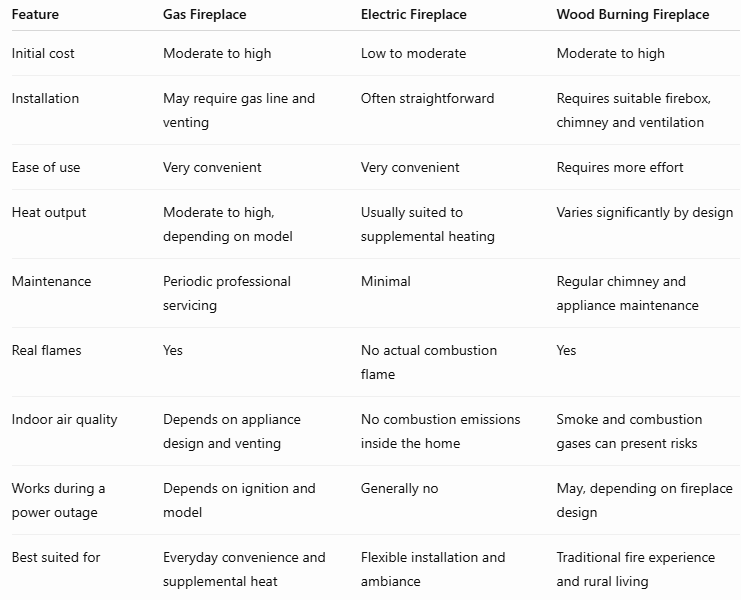
Gas vs. Electric vs. Wood Fireplace: Quick Comparison

Costs and performance vary by model, installation requirements and the condition of the existing fireplace. An open wood burning fireplace, for example, performs very differently from a modern, high efficiency wood insert.

1. Gas Fireplaces: Convenient, Comfortable and Popular

A gas fireplace offers the look of a real flame without the work involved in storing firewood, lighting a fire and cleaning up ashes. Many models operate with a wall switch or remote control, making them an attractive option for busy households.

Gas fireplaces can be particularly appealing during Calgary's long heating season, when homeowners want to enjoy a fire without making it a major undertaking.

Advantages of a gas fireplace

Convenient operation: Most models can be switched on and off easily, with some offering thermostats, timers and adjustable flame settings.

Supplemental heat: Depending on the model and room layout, a gas fireplace can provide useful heat to a living room or other frequently used space.

Less mess: There is no firewood to carry inside and no wood ash to clean up.

Design flexibility: Gas fireplaces are available in traditional styles, contemporary linear designs and inserts that can be installed into some existing masonry fireplaces.

Potential buyer appeal: A well maintained gas fireplace can be an attractive feature for buyers who value comfort and convenience.

Disadvantages of a gas fireplace

Installation costs: Adding a gas fireplace can be expensive if a gas line, venting system or structural modifications are required.

Ongoing operating costs: Natural gas or propane consumption contributes to operating costs. Efficiency varies considerably between models.

Maintenance requirements: Gas fireplaces need appropriate inspection and servicing to help ensure safe operation.

Dependence on fuel and electricity: Some models may continue operating during a power outage, while others will not. The ignition system and manufacturer's specifications determine what is possible.

Are gas fireplaces energy efficient?

Some gas fireplaces are designed primarily for appearance, while others are built to provide meaningful supplemental heat. These are not interchangeable uses.

When comparing models in Canada, look for the EnerGuide Fireplace Efficiency rating. Natural Resources Canada explains that a higher Fireplace Efficiency rating indicates better efficiency, allowing homeowners to compare models more meaningfully.

It is also important to remember that a gas fireplace generally heats a particular area rather than replacing a home's central heating system.

Best for: Homeowners who want real flames, convenient operation, supplemental heat and relatively low day to day maintenance.

2. Electric Fireplaces: Affordable, Flexible and Low Maintenance

Electric fireplaces have become increasingly popular because they can add the look of a fireplace without requiring a traditional chimney or a fuel supply.

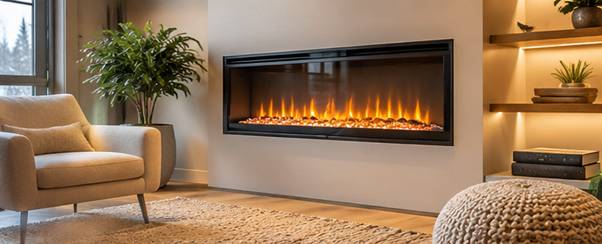
They are available as wall mounted units, recessed installations, freestanding fireplaces and electric inserts. This flexibility makes them particularly useful for condos, townhomes, renovated basements and homes where installing a gas or wood burning fireplace would be difficult.

Advantages of an electric fireplace

Lower installation costs: Many models require little more than an appropriate electrical connection, although recessed installations and electrical upgrades can add to the cost.

No chimney or combustion venting: Electric fireplaces do not burn fuel, so they do not produce combustion gases inside the home.

Simple operation: Many models include remote controls, adjustable flame effects and separate heat settings.

Minimal maintenance: There is no chimney to sweep, ash to remove or burner system to service in the same way as a fuel burning fireplace.

Flexible placement: Electric fireplaces can work well in spaces where a conventional fireplace would be impractical, provided the installation follows electrical and manufacturer requirements.

Decorative appeal: Modern units can create an attractive focal point in a living room, bedroom or basement recreation area.

Disadvantages of an electric fireplace

Limited heating capacity: Many common electric fireplaces provide supplemental heat for one room rather than heating an entire house.

No real combustion flame: The flame effect is simulated. Some premium models create a convincing visual effect, but they do not reproduce a real wood fire.

Electricity costs: Operating costs depend on the unit's power consumption, how long it runs and local electricity rates.

Electrical limitations: Older homes may require electrical upgrades for certain installations.

Are electric fireplaces cheaper to operate?

Electric fireplaces are often inexpensive to install, but the cost to run one depends on its wattage and how frequently it is used.

For example, a 1,500 watt electric fireplace running at full power for four hours uses approximately 6 kilowatt hours of electricity. To estimate the cost, multiply 6 kWh by your electricity rate per kWh, including any applicable charges.

Electric resistance heating converts electricity into heat at the point of use, but that does not automatically make it the cheapest heating option. Compare local electricity and gas costs, the fireplace's output and how you plan to use it.

Best for: Condo owners, homeowners on a budget, basement renovations and anyone who wants fireplace ambiance with minimal installation and maintenance.

3. Wood Burning Fireplaces: Traditional Charm and a Real Fire Experience

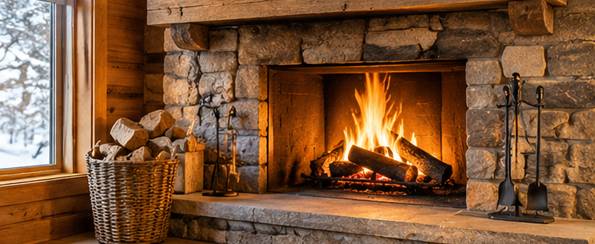
For many people, nothing compares with the sound, smell and appearance of a real wood fire. A wood burning fireplace can create a traditional gathering place and complement rustic, country and acreage properties around Calgary.

However, wood burning fireplaces require more attention than gas or electric alternatives, and the design of the appliance makes a significant difference to its performance.

Advantages of a wood burning fireplace

Authentic atmosphere: Real flames, glowing embers and the sound of burning wood create an experience that electric and gas fireplaces cannot completely reproduce.

Independence from natural gas: A wood burning appliance does not require a natural gas supply.

Potential backup heat: A properly designed wood stove or fireplace insert may provide useful heat during a power outage, depending on its design and operating requirements.

Appeal for certain buyers: Wood burning fireplaces can be especially attractive in rural homes, acreages, cabins and properties where a traditional fire suits the setting.

Disadvantages of a wood burning fireplace

More maintenance: Firewood must be purchased or collected, stored and carried. Ash and soot also need to be managed.

Chimney cleaning and inspection: Wood burning appliances require regular inspection and cleaning as needed.

Smoke and air quality: Wood combustion produces pollutants. Poor drafting or improper operation can also allow smoke and combustion gases to enter the home.

Heat loss with some designs: Traditional open fireplaces can draw heated indoor air up the chimney. They may provide less useful heat than homeowners expect.

Insurance considerations: Insurers may ask for documentation, inspection or other conditions for wood burning appliances. Confirm requirements with your insurer before purchasing a home or installing a unit.

There are companies that will do fireplace conversions if you find the perfect home, but don’t want a wood burning fireplace.

Is a wood burning fireplace efficient?

It depends on the appliance.

An older, open masonry fireplace is often more decorative than efficient and can contribute to heat loss. A modern, properly installed wood stove or high efficiency fireplace insert can provide substantially better heating performance.

If you are considering a home with a wood burning fireplace, ask about the age and condition of the appliance, chimney maintenance, installation documentation and any inspection requirements.

Best for: Homeowners who value a traditional fire, are comfortable with regular maintenance and want a fireplace that suits a country home or acreage lifestyle.

Which Fireplace Is Cheapest to Install?

The cheapest option depends on the home and the work required.

An electric fireplace is often the least expensive to install because many models do not require a gas line or combustion venting. A gas fireplace may cost more if new gas connections and venting are needed. A wood burning fireplace can involve substantial installation costs if a suitable chimney, hearth and firebox are not already in place.

When comparing quotes, consider the complete project rather than the appliance price alone.

Include:

  • The fireplace unit and any surround or finishing materials

  • Electrical or gas connections

  • Venting or chimney requirements

  • Labour and installation permits where applicable

  • Required inspections

  • Ongoing maintenance and operating costs

If a home already has a fireplace, converting it may be less expensive than building a completely new installation, but the existing structure must be suitable for the proposed appliance.

Which Fireplace Is Cheapest to Operate?

There is no single answer for every Calgary household. Operating costs depend on fuel prices, appliance efficiency, heat output and how often the fireplace is used.

An electric fireplace can be economical for occasional use in one room, while a high efficiency gas fireplace may be attractive for frequent supplemental heating. Wood costs vary depending on the supply, type of wood and whether it is purchased or sourced by the homeowner.

Before choosing, consider these questions:

  1. Will the fireplace be used occasionally for ambiance or regularly for heat?

  2. What is the appliance's actual heat output?

  3. What is its efficiency rating?

  4. How much does the fuel cost locally?

  5. Will it reduce the need for your central heating system, or simply add extra warmth?

Remember that a fireplace is not automatically an economical way to heat an entire home. A well designed central heating system is generally better suited to whole house heating.

Which Fireplace Adds the Most Value to a Calgary Home?

A fireplace can help create an inviting atmosphere and improve a home's presentation, but no fireplace type guarantees a specific increase in resale value.

Its appeal depends on the property, the neighbourhood, buyer preferences and the quality of the installation.

Gas fireplaces and resale appeal

Gas fireplaces offer convenience and are often attractive to buyers who want an easy to operate feature. A modern, well maintained fireplace that complements the living space can help make a home feel more inviting.

Electric fireplaces and resale appeal

Electric fireplaces can enhance the appearance of a living room or finished basement without requiring a major renovation. However, a decorative unit should not automatically be treated as a value adding capital improvement.

Wood fireplaces and resale appeal

Wood burning fireplaces may appeal strongly to buyers seeking an acreage, cabin or traditional home. Other buyers may be concerned about maintenance, smoke, insurance requirements or the condition of the chimney.

What matters most to buyers?

In Calgary real estate, the overall presentation and functionality of a home matter more than simply having a particular type of fireplace. A fireplace that fits the home's style, is in good working condition and is properly maintained is more likely to be an asset than an outdated or poorly maintained installation.

If you are renovating before selling, compare the cost of the upgrade with the likely buyer appeal in your specific neighbourhood before committing to an expensive project.

Fireplace Safety and Maintenance: What Calgary Homeowners Should Know

Regardless of the type of fireplace you choose, safe installation and regular maintenance are essential.

  • Gas fireplaces: Follow the manufacturer's maintenance schedule and have the appliance inspected or serviced by a qualified professional when required.

  • Electric fireplaces: Follow electrical and clearance requirements, keep air intakes and outlets unobstructed, and use the unit according to the manufacturer's instructions.

  • Wood burning fireplaces: Arrange regular chimney and appliance inspections, clean the chimney as needed and use appropriate, properly seasoned firewood.

Homes with combustion appliances should have working carbon monoxide alarms installed in accordance with applicable requirements. Natural Resources Canada also recommends paying attention to combustion safety and the potential for carbon monoxide spillage from fuel burning appliances.

For additional guidance, consult Natural Resources Canada’s fireplace information and its guidance on combustion gases in the home.

Frequently Asked Questions About Gas, Electric and Wood Fireplaces

Is a gas fireplace better than an electric fireplace?

A gas fireplace is generally better for homeowners who want real flames and potentially greater supplemental heat. An electric fireplace is often better for affordability, flexible installation and minimal maintenance. The best option depends on your heating requirements, budget and home.

Is a wood burning fireplace better than a gas fireplace?

A wood burning fireplace provides an authentic fire experience and may offer backup heat with a suitable appliance. A gas fireplace is easier to operate and usually requires less day to day maintenance. For convenience, gas often has the advantage. For traditional ambiance, some homeowners prefer wood.

Which fireplace is most energy efficient?

Efficiency depends on the model and how it is used. For gas fireplaces, compare the Canadian EnerGuide Fireplace Efficiency rating. Modern wood burning appliances can perform much better than traditional open fireplaces. Electric resistance fireplaces convert electricity into heat at the point of use, but operating cost depends on electricity rates and consumption.

Can an electric fireplace heat a whole house?

Most standard electric fireplaces are designed to provide supplemental heat to a room, not replace a home's central heating system. Their effectiveness depends on the unit's output, room size, insulation and layout.

Can a gas fireplace work during a power outage?

Some gas fireplaces can operate during a power outage, but others depend on electricity for ignition, controls or fans. Check the specific model's operating instructions rather than assuming every gas fireplace will work without power.

Does a fireplace increase home resale value?

A fireplace can improve buyer appeal and help a home feel more inviting, but its financial impact varies. Condition, design, installation quality and local buyer preferences all matter. The cost of installing a fireplace may not be fully recovered at resale.

Is a wood burning fireplace a good choice for an acreage near Calgary?

It can be an appealing option for buyers who enjoy a traditional fire and are comfortable with wood storage and maintenance. Before buying, check the appliance and chimney condition, confirm insurance requirements and understand any local restrictions that may apply.

Should I convert my wood burning fireplace to gas?

A gas conversion may make sense if you want less maintenance and easier operation. However, the cost depends on the existing fireplace, gas supply, venting and installation requirements. Obtain a professional assessment and compare the conversion cost with the benefits you expect.

The Bottom Line: Which Fireplace Should You Choose?

The best fireplace is the one that suits your home, budget and lifestyle.

  • Choose gas if you want real flames, convenient operation and useful supplemental heat.

  • Choose electric if you want an affordable, flexible and low maintenance option for ambiance and occasional warmth.

  • Choose wood if you value the traditional fire experience and are prepared for the added work and maintenance.

If you are buying a home in Calgary, look beyond the appearance of the fireplace. Ask about its age, operating condition, maintenance history and installation requirements. If you are renovating before selling, consider whether the investment will appeal to buyers in your neighbourhood.

A fireplace should complement your home, not become an expensive feature that does not suit the way you live.

The key is to focus on improvements that make your home feel welcoming, functional, well maintained and easy to enjoy.

If you are considering selling your Calgary home, a good place to start is by looking at your property from the perspective of a potential buyer. What would you notice first? What looks tired or neglected? And what could be improved without spending more than the improvement is likely to be worth?

Sometimes the biggest difference comes from the simplest changes.

Thinking about selling your Calgary home? Contact Chris Marshall Calgary Realtor for a home evaluation and personalized advice about which improvements are worth making before you list.

About Chris Marshall  |  Chris Marshall is an Associate Broker and REALTOR with RE/MAX House of Real Estate, serving buyers and sellers across Calgary and surrounding communities. A Certified Condominium Specialist with over 23 years of Calgary market experience, Chris specializes in helping clients navigate all stages of their real estate journey. Visit chrismarshallrealtor.com or call 403 585 5362.

Looking for community info, market stats & schools:

Looking for a particular lifestyle:

Other Blogs:

Read

50 Things to Get Rid of Without Regret

Simple Decluttering Ideas to Create a More Organized Home

Decluttering your home does not mean getting rid of everything you own or creating a house that feels empty.

Sometimes, the easiest place to start is with the things you already know you do not need.

A chipped mug. A drawer full of mystery cables. Clothes you never wear. An empty bottle you have been saving for no particular reason. A kitchen gadget that seemed like a great idea at the time.

These little things can quietly take over our homes.

The good news is that decluttering does not have to be overwhelming. You do not need to tackle the entire house in one weekend. Instead, start with a drawer, cupboard, shelf or small category and make a few simple decisions.

If you are wondering what to get rid of when decluttering, here are 50 things you can consider letting go of without regret.

🍽️ In the Kitchen

The kitchen is one of the easiest places for clutter to accumulate. Food gets pushed to the back of cupboards, containers lose their lids and gadgets that seemed useful at the time rarely see the light of day. A great place to start as there is less emotional attachment to items in the kitchen.

1. Out of Date Food

Check the back of your cupboards, refrigerator and freezer.

Food that is past its recommended date, has changed in quality or that you know you are never going to eat does not need to take up valuable storage space. Grab a compost bin or bag go through the fridge & freezer. Next check the spices, teas… yes they have expiry dates. Baking supplies, flour expires.

2. Chipped Plates and Mugs

Take a look at your everyday dishes.

Keep the ones that are in good condition and that you actually use. If you have a cupboard full of chipped mugs and plates that rarely make it into your daily rotation, it may be time to let some go.

3. Containers Without Their Lids

If the lid has disappeared, the container probably needs to go.

You do not need an entire collection of containers that cannot actually be used for storing food. For those you aren’t sure of, grab a box and put every lid without a bottom and every bottom without a lid, put this box away with a note on your calendar 3-12 months (you pick) from now. If you haven’t touched that box when the date comes up, toss it all.

If you have glass bottoms with missing, broken, worn-out lids; toss the broken and worn out lids, then order new lids that fit the bottoms.

4. Duplicate Utensils

How many spatulas, wooden spoons and serving utensils do you really need?

Keep your favorites and let go of the ones permanently sitting at the back of the drawer. Check those plastic & rubber spatulas, if there is any sign of the plastic cracking, breaking or wearing down, toss them in the garbage (even if they are your favorite).

5. Old Spices

Check those spice jars you bought for one recipe and never touched again.

If you cannot remember when you bought it or what recipe you purchased it for, take a look at the product guidance and decide whether it is still worth keeping. Check the expiry date, toss all expired spices.

6. Kitchen Gadgets You Never Use

If you have forgotten what a kitchen gadget does, it probably does not need prime cupboard space.

Ask yourself whether you have actually used it recently and whether you would buy it again today. If you haven’t used it in 12-24 months, do you really need to keep it?

7. Worn Wooden Spoons

Take a look at wooden utensils for cracks, splitting or other damage.

Keep the ones in good condition and replace those that are no longer suitable for regular use.

8. Excess Tea Towels

Tea towels have a way of multiplying.

Keep enough for your household and washing routine and consider donating or repurposing the extras.

9. Old Takeaway Menus

Do you still have a drawer full of restaurant menus?

Many menus can now be found online, so there may be little reason to keep stacks of old paper menus.

10. Empty Jars and Tubs

One or two empty containers can be useful.

Twenty empty jars and tubs being saved "just in case" are another story. You can let these go, there are more where they came from.

Keep the amount that you realistically use and recycle the rest where appropriate.

11. Plastic Bags

Plastic bags can quickly accumulate under the kitchen sink or in a pantry.

Keep a sensible amount for the ways you actually use them and recycle or reuse the rest where possible. The same goes for reusable grocery bags. Can’t bear to throw those out? use them to collect donation items & then they go out with the drop off.

12. Old Food Packaging

Clear out boxes, wrappers and containers that you no longer need. 

Packaging can take up surprisingly large amounts of storage space, particularly in kitchen cupboards and drawers.

🛋️ Around the Living Room

Living rooms often become the landing place for paperwork, magazines, decorations, electronics and things that belong somewhere else.

A quick decluttering session can make the entire room feel more spacious and peaceful.

13. Old Magazines and Newspapers

If you have not read them by now, are you realistically going to?

Keep special editions or genuinely meaningful publications and recycle the rest. Donate to libraries or schools if you can’t bear to toss them.

14. Broken Remote Controls

Broken remote controls have a tendency to remain in drawers long after the appliance they belonged to has disappeared. Toss all broken remotes.

If you no longer own the device, there is no reason to keep the remote.

15. Cables You Cannot Identify

Mystery cables are one of the most common forms of household clutter.

Put them together and work out what they belong to before deciding what stays. Gather all the cords and sort through, there’s likely outdated and duplicates. 

If you cannot identify a cable and have no realistic reason to keep it, consider recycling it through an appropriate electronics recycling program.

16. Decor You No Longer Like

Your home does not have to keep displaying something just because you once loved it.

Styles change. Tastes change. Your life changes.

If a piece of decor no longer suits your home or makes you happy, consider giving it a new home.

17. Empty Candles

Once a candle has completely finished, there is no reason to keep the empty container unless you have a specific use for it. Do you have an excessive amount of candles? Consider tossing any candle with synthetic scents. 

Recycle or repurpose the container where appropriate.

18. Too Many Cushions

Cushions can make a room comfortable and inviting, but too many can take over a sofa or chair.

Keep the ones that genuinely make your room feel cozy and let go of the extras. If the cushion is old and musty, it might be time to let that go.

19. Worn Out Blankets

Look through your blankets and throws.

Anything damaged beyond repair does not need to live in your cupboards forever. If time permits, donate to an animal shelter. If you have several, but not the time to drop off, post on social media for free pick up.

20. Old Receipts

Keep receipts and records that you genuinely need and dispose of the rest appropriately. Older than seven years, toss. Have a box for each year clearly labeled. 

A small receipt pile can quickly turn into an entire drawer of paper clutter.

21. Paper Clutter

Old leaflets, takeaway menus, notes, advertisements and random pieces of paper can quickly build up.

Sort through the pile and decide what actually needs to be kept. Be diligent when paper enters the house, toss anything that can be tossed immediately. 

22. Broken Ornaments

You do not have to keep something simply because it has been in your home for years.

If an ornament is broken and you have no intention of repairing it, it may be time to let it go. Broken ornaments, decor, are sitting in the back of your mind, causing unnecessary stress - you don’t need to keep these, let them go for a more peaceful home.

23. Decorations You Never Put Out

If decorations have stayed in the cupboard year after year, ask yourself why.

If you consistently choose other decorations instead, someone else may enjoy the ones you no longer use.

24. Things Waiting to Be Repaired

This can be one of the hardest categories.

Be honest about whether you are actually going to fix it.

If something has been waiting for repair for years, the fact that you have not repaired it may tell you something. Let it go, free up the mental space. 

🛏️ In the Bedroom

Bedrooms should be restful spaces, but closets and drawers can quickly become storage areas for things we no longer wear or use.

25. Clothes That No Longer Fit

Your wardrobe should work for the body and lifestyle you have now.

Clothing that you never wear does not need to take up valuable closet space. If you don’t feel great when you wear it, pass it on.

26. Clothes You Always Avoid Wearing

There is usually a reason you keep reaching past certain clothes.

Maybe they are uncomfortable, difficult to style or simply not your favorites.

You do not need to keep wearing something just because you own it.

27. Shoes You Never Wear

Uncomfortable shoes are not useful just because they are still technically wearable.

If you consistently choose other shoes instead, consider whether someone else could get more use from them.

28. Broken Hangers

Broken and bent hangers make closets harder to organize.

Remove them and make space for the clothes you actually wear.

29. Old Pajamas

Keep the comfortable pajamas you genuinely reach for.

If you have far more than you need, consider letting go of worn or unused pairs.

30. Accessories You Have Forgotten About

Look through jewelry, scarves, belts and other accessories.

If you cannot remember the last time you wore something, think carefully before giving it another permanent home in your closet.

31. Overfilled Drawers

If you have to force a drawer shut, it is probably time for a sort out.

Remove items you no longer use and reorganize what remains so everything is easy to access.

32. Bedding You Never Use

Keep the bedding that fits your beds and suits your household.

There is little point keeping multiple sets that never leave the linen closet. Donate what you aren’t using, someone is in need and would truly appreciate it. Animal shelters are happy to take bedding that is a little worn. 

33. Empty Boxes

Unless you have a genuine reason to keep them, recycle empty boxes.

Ask yourself whether you are keeping them for a specific future purpose or simply because throwing them away feels wasteful. If you have multiple, you could post ‘free moving boxes’ on social media, they will go quick.

34. Old Handbags and Bags

Keep the bags you actually use.

If you have accumulated handbags, backpacks, tote bags and other bags that have not been used in years, consider donating them.

35. Clothes With the Tags Attached

If you bought something and it still has the tags attached months or years later, ask yourself whether you really will wear it.

Someone else may get much more use from it.

36. Odd Socks

Give them one last chance to find their partner.

If the missing sock has not appeared after a reasonable amount of time, let the odd one go.

37. Damaged Clothing

If clothing cannot realistically be repaired or repurposed, it does not need to take up wardrobe space.

Depending on its condition and local programs, consider donation, textile recycling or appropriate disposal.

38. Clothes Kept for a Future Version of Yourself

This can be an especially difficult category.

Your wardrobe should reflect your real life, not an imaginary one.

Keep the clothing that suits the life you actually live and makes getting dressed easier.

🛁 In the Bathroom

Bathrooms tend to contain lots of small products, many of which are easy to forget about.

A quick cupboard and drawer cleanout can make a surprisingly big difference. Toss all expired items. Partially used, but know you won’t use anymore, toss that too.

39. Empty Bottles

Once a product is finished, recycle the container where possible.

Do not let empty shampoo, conditioner, body wash and skincare bottles continue taking up valuable bathroom space. Can you pour them all into one container?

40. Old Skincare Products

Check the product guidance and the period after opening symbol where applicable.

If a product is old, has changed in appearance or smell, or is no longer appropriate for use, follow the manufacturer's guidance for disposal.

41. Makeup You Never Use

Keeping something you dislike will not make you suddenly start using it.

If a product has been sitting untouched in a makeup drawer for a long time, consider whether it deserves the space. Makeup expires, toss it.

42. Old Toothbrushes

Replace toothbrushes when needed. Worn out? Toss it.

An old toothbrush may also be useful for certain cleaning jobs, but once it has served its purpose, dispose of it appropriately.

43. Toiletries You Do Not Like

You do not have to keep something simply because you bought it.

If you genuinely dislike using a product, consider whether someone else could use it or whether it should be disposed of appropriately.

44. Nearly Empty Products You Keep Ignoring

You know the ones.

They are almost empty, but you keep moving them around the bathroom instead of finishing them.

Either use them up or make a decision about whether they are worth keeping. 

45. Old Holiday Toiletries

Those tiny bottles and travel size products can quickly become drawer clutter.

Keep the ones you genuinely use for travel and let go of the rest appropriately.

46. Worn Towels

Keep enough good towels for your household and washing routine.

Towels that are worn out, damaged or no longer useful can be repurposed where appropriate or disposed of according to local textile recycling options. Again, animal shelters are happy to take worn towels.

47. Duplicate Toiletries

Do you really need several opened versions of the same product?

Try to finish what you already have before opening another whenever practical.

🧺 The Random Clutter

Some clutter does not belong to a particular room.

It is the collection of things that we keep because we might need them someday, because they cost money or simply because we have become accustomed to seeing them.

48. Things You Are Keeping Just in Case

Ask yourself how often that situation has actually happened.

If you have kept something for five years "just in case" and never used it, consider whether the space it occupies is worth more to you than the item itself.

Can you replace it quickly for less than $40?

49. Items You No Longer Use but Feel Guilty Throwing Away

The money has already been spent.

Keeping the item will not bring the money back.

If you no longer use it, need it or want it, consider whether donating, selling or recycling it would be a better use of the item.

50. Anything You Do Not Use, Need, Love or Have a Genuine Reason to Keep

This is my favorite final question.

When you are stuck deciding whether something should stay, ask yourself:

Do I use it?

Do I need it?

Do I love it?

Do I have a genuine reason to keep it?

If the answer to all four questions is no, you may have your answer.

What Should You Do With the Things You Remove?

Decluttering does not automatically mean putting everything into the garbage. If you have the time to drop off, then it’s easy enough to do. Posting a free for pick up on Facebook is a great option. And if it means getting on top of a overwhelming situation, throwing in the garbage is valid.

Before throwing something away, consider whether it can be:

Donated: Clothing, household goods, books and other usable items may be useful to someone else.

Sold: Higher value furniture, electronics, sporting equipment and other desirable items may be worth selling.

Recycled: Paper, cardboard, electronics, containers and other materials may have appropriate recycling options.

Repurposed: Some old towels, clothing and containers may have another practical use.

Properly disposed of: Certain products require specific disposal methods. Check local guidelines before putting questionable items in the garbage. For example: paint, aerosol cans, bear spray, propane tanks should all be dropped off at a local fire department. 

How to Declutter Without Feeling Overwhelmed

You do not have to declutter your entire home at once.

Try choosing one small area.

A single kitchen drawer.

One bathroom cupboard.

One shelf.

One clothing category.

One box.

Set aside a short amount of time and make decisions quickly where you can. It’s worth it.

A useful rule is to create four categories:

Keep

Things you use, need or genuinely value.

Donate

Things that are still useful but no longer needed by you.

Sell

Items that have enough value to justify the effort of selling them.

Recycle or Dispose

Items that are broken, expired or no longer suitable for use.

Once you have made your decisions, remove the items from the room. Otherwise, there is a risk that the donation pile simply becomes another pile of clutter.

Decluttering Before Selling Your Home

Decluttering can be particularly valuable if you are preparing to sell your home.

Buyers need to be able to see the space, storage and potential of a property.

A crowded home can make rooms appear smaller and closets appear less functional.

Before listing, consider removing excess furniture, overly large furniture, personal collections, countertop clutter and items stored in hallways or entry areas.

You do not need to make your home look empty.

The goal is to make it easier for potential buyers to see the home itself.

A well organized, clean and uncluttered home can also make photography more effective and help your online listing photos showcase the property.

The Bottom Line

Decluttering is not about owning as little as possible.

It is about making room for the things that matter. Having a peaceful home.

When you remove things you no longer use, need or enjoy, your home can become easier to clean, easier to organize and more enjoyable to live in.

And if you are preparing to move, downsizing or selling your home, decluttering can make the process considerably easier.

Start small.

Choose one drawer.

Then one cupboard.

Then one room.

You may be surprised by how much easier it feels once you start.

Less clutter means fewer things to organize, fewer things to clean and more space to enjoy.

Frequently Asked Questions About Decluttering

What should I get rid of first when decluttering?

Start with things that are obviously no longer useful, such as expired food, empty containers, broken items, duplicate household goods and clothing you never wear.

How do I declutter without regretting what I throw away?

Start with items you already know you do not use. For anything you are unsure about, ask whether you use it, need it, love it or have a genuine reason to keep it.

What should I do with things I no longer want?

Depending on the item, consider donating, selling, recycling, repurposing or disposing of it appropriately. 

Should I declutter before selling my home?

Yes. Removing unnecessary belongings can help rooms look more spacious, make storage areas easier for buyers to see and allow listing photographs to showcase the property more effectively. Decluttering helps with organizing your home whether you are selling or not.

How can I declutter when I feel overwhelmed?

Start very small. Choose one drawer, shelf or cupboard rather than trying to tackle the entire house. Small improvements can build momentum.

Is decluttering the same as minimalism?

No. Decluttering simply means removing things you no longer need, use or want. You can have a comfortable, decorated and personalized home without having excessive clutter.

What is the easiest decluttering rule to follow?

Ask yourself whether you use it, need it, love it or have a genuine reason to keep it. If none of those apply, it may be time to let it go.

Before you throw anything away, always check whether it should be recycled, donated, sold or disposed of in a particular way. Do make sure paint, propane tanks, expired bear spray are disposed of properly. That said do not spend a month of Sunday’s trying to get everything in the exact place. 

Your goal is not an empty home.

Your goal is a home where the things you own are useful, loved or genuinely important to you.

You don’t have to do this alone!

Megan Golightly at GoSimplified. Check out Megan’s organizing services: https://www.go-simplified.com/shop-services 

Find inspiration from GoSimpilified on Social Media:
Instagram
Facebook
YouTube
TikTok
Pinterest

Living in a cluttered space doesn’t mean you’re messy, it usually means life got busy and things accumulated without notice. The good news? You can take back control, one step at a time. With 5, 10 or 20 minutes per day. Start small, stay consistent, and remember: your home should serve you, not the stuff inside it. 

Figuring out your organizing style will help you stay organized and understand the organizing styles of those you live with goes a long way in creating systems that will stick. Check out the Clutterbug quiz: https://clutterbug.me/ 

Listening to podcasts has made a huge difference for some of our clients. Favorites:

Clutterbug: Real life Hacks and Tips to Declutter, Organize and Clean Your Home Fast

Dana K White: A Slob Comes Clean

How Decluttering can Transform Your Life by Megan Golightly

Other Organizing Blogs:

Thinking about selling your Calgary home? Contact Chris Marshall Calgary Realtor for a home evaluation and personalized advice about which improvements are worth making before you list.

About Chris Marshall  |  Chris Marshall is an Associate Broker and REALTOR with RE/MAX House of Real Estate, serving buyers and sellers across Calgary and surrounding communities. A Certified Condominium Specialist with over 23 years of Calgary market experience, Chris specializes in helping clients navigate all stages of their real estate journey. Visit chrismarshallrealtor.com or call 403 585 5362.

Looking for community info, market stats & schools:

Looking for a particular lifestyle:

Other Blogs:

Read

Best Coffee Shops in Calgary: Local Cafés Worth Seeking Out

There is something special about finding a great local coffee shop.

It might be the smell of freshly roasted beans when you walk through the door. It might be the barista who remembers your order, the cozy corner where you can catch up with a friend, or the little neighbourhood café that has been part of Calgary for decades.

Calgary has developed an impressive coffee culture, with independent cafés, specialty coffee roasters, creative neighbourhood coffee shops and some remarkably talented baristas. In fact, Calgary has become home to several coffee companies with national and international recognition.

For this list, we are leaving out the big chain style coffee shops and focusing on places with personality. Some are serious specialty coffee destinations. Others are beloved neighbourhood institutions. A few are tucked away in unexpected locations and are worth discovering.


Caffe Beano

📍 1613 9 Street SW

If you want to experience a piece of Calgary coffee history, start at Caffe Beano.

A Calgary original since 1990, Beano has become much more than a place to grab a cup of coffee. It has a distinctly local personality, with regulars, artists, students, neighbours and coffee lovers filling the café.

The coffee leans bold and robust, while the in-house baked goods are another reason people keep coming back. Beano is particularly well known for its chocolate espresso milkshake.

Why visit: Calgary history, strong coffee, fresh baking and a genuine neighbourhood atmosphere.


Phil & Sebastian Coffee Roasters

📍 Simmons Building, East Village

Phil & Sebastian is one of the names that helped shape Calgary's modern specialty coffee scene.

The Simmons Building location is particularly memorable. Located inside the beautifully restored historic building along the Bow River, it combines architecture, coffee and Calgary's East Village atmosphere in one destination.

For coffee enthusiasts, the rotating selection of carefully sourced coffees and precise brewing methods make this much more than an ordinary café stop.

Why visit: Specialty coffee, historic architecture and one of Calgary's most recognizable local coffee brands.


Sought x Found Coffee Roasters

📍 Crescent Heights and Beltline

Sought x Found is a wonderful choice for anyone who wants to explore coffee beyond the standard latte or Americano.

The Calgary roaster focuses on specialty coffees and offers rotating selections that highlight different origins, processing methods and flavour profiles. Their coffee flights are an especially fun way to discover how dramatically different coffees can taste.

The original Crescent Heights location has a relaxed neighbourhood feel, while the Beltline location offers another convenient option.

Why visit: Coffee flights, rotating specialty beans and a more educational coffee experience.


Paradigm Spark

📍 422 11 Avenue SE

Paradigm Spark is one of Calgary's newer coffee destinations, but it has already made a name for itself among specialty coffee enthusiasts.

The café combines roasting, brewing, coffee education and experimentation. Guests can explore single-origin coffees, espresso and pour-over preparations, while the Experience Bar offers an opportunity to try more unusual coffee creations.

The café is also home to Timberline Coffee School.

Why visit: Coffee education, specialty brewing, single-origin coffees and a genuinely different coffee experience.


The Roasterie

📍 314 10 Street NW

Tucked into Kensington, The Roasterie has the kind of old-school character that makes a coffee shop memorable.

Coffee is roasted on site, and the shop has long been known for its distinctive atmosphere and hands-on approach to coffee.

It is a great choice when you want something that feels authentically local rather than polished and corporate.

Why visit: In-house roasting, neighbourhood character and a classic Calgary coffeehouse experience.


Kesh Kesh Coffee Roastery

📍 204 7A Street NE

Located in Bridgeland, Kesh Kesh brings a strong East African influence to Calgary's coffee scene.

The café roasts its own coffee and draws inspiration from Eritrean coffee traditions. The space has a cozy, welcoming feel that makes it easy to settle in for a while.

It is an especially interesting destination for anyone curious about the cultural traditions surrounding coffee.

Why visit: East African coffee influence, in-house roasting and a welcoming neighbourhood atmosphere.


Q.Lab by Chronicle Coffee Roasters

📍 926 16 Avenue SW

Q.Lab takes the idea of a coffee shop and turns it into something closer to a tasting experience.

Located in Calgary's Beltline, Q.Lab focuses on specialty coffees, tasting flights, pour-over brewing and coffee education. It is the sort of place where you can spend a little more time exploring what is actually in your cup.

Why visit: Coffee flights, rare coffees and a deeper dive into specialty coffee.


Eight Ounce Coffee Club Café

📍 Portland Street SE

This is one of Calgary's more unusual coffee destinations.

Eight Ounce is best known as a specialty coffee equipment company, but its café allows visitors to taste coffees from around the world while surrounded by an impressive selection of brewing equipment.

Coffee flights and pour-over options make this a particularly fun destination for anyone who enjoys comparing different beans and brewing methods.

Why visit: Coffee flights, specialty equipment and a coffee experience unlike a traditional café.


Calgary Heritage Roasting Company

📍 2020 11 Street SE

Located in a historic Calgary setting, Calgary Heritage Roasting Company combines local history with small-batch coffee roasting.

The company has a particularly interesting story and a strong emphasis on coffee, community and sustainability.

The café is a good option if you enjoy a coffee experience that feels connected to Calgary's history and local business community.

Why visit: Local history, in-house roasting and a distinctive Calgary setting.


Caffè Gravity

📍 Inglewood and other Calgary locations

Gravity is more than a coffee shop.

The Inglewood location doubles as a community gathering place, wine bar and live music venue, giving it a different personality from many of Calgary's specialty cafés.

During the day, it is a comfortable place for coffee and conversation. Later, the atmosphere can shift toward food, drinks and live entertainment.

Why visit: Coffee, community, live music and a lively Inglewood atmosphere.


Congress Coffee Company

📍 215 36 Avenue NE

Congress Coffee is one of those places that feels like it was designed around the idea of a neighbourhood gathering place.

Located in an unexpected industrial area, it combines coffee with art, music and community events. The atmosphere has a nostalgic coffeehouse quality that feels very different from the polished look of many newer cafés.

Why visit: Local art, music, community events and a wonderfully unconventional atmosphere.


I Love You Coffee Shop

📍 Beltline

The name alone should tell you that this isn't your typical coffee shop.

I Love You Coffee Shop blends coffee with music, vinyl records and a distinctly Japanese inspired atmosphere. It feels more like a hidden neighbourhood clubhouse than a traditional café.

If you're looking for somewhere with personality, this one belongs on your list.

Why visit: Vinyl records, music, unique atmosphere and a coffee experience that feels completely different.


Caffè Beano Uxborough

📍 Uxborough, NW Calgary

For those who love the character of Caffe Beano but live in northwest Calgary, the Uxborough location offers another way to experience this Calgary original.

It maintains the independent, community-focused spirit that has made Beano part of Calgary's coffee culture for more than three decades.

Why visit: Local history, neighbourhood atmosphere and the unmistakable Beano personality.


Higher Ground Café

📍 Kensington

Higher Ground has been part of Calgary's independent café scene for years and remains a popular place to meet friends, enjoy a meal or settle in with a coffee.


Its focus on organic and fair-trade coffee adds another reason to visit, while the extensive food menu makes it suitable for more than just a quick caffeine stop.

Why visit: Relaxed atmosphere, organic coffee, all-day food and plenty of space to linger.

Weeds Café

📍 1903 20 Avenue NW

Weeds Café is a long-running Calgary neighbourhood favourite in the Capitol Hill area.

It has a comfortable, slightly eclectic character and offers coffee, tea, sandwiches, bagels and other casual café fare.

This is a good choice when you want a traditional neighbourhood coffee shop rather than a destination built entirely around specialty coffee.

Why visit: Cozy atmosphere, neighbourhood character and a relaxed place to catch up with friends.


Euphoria Café

📍 Varsity

Euphoria Café is a local northwest Calgary favourite that combines specialty coffee with bakery items, sandwiches and café-style food.

It has a welcoming neighbourhood atmosphere and is a particularly convenient option for anyone living in or visiting Varsity and the surrounding northwest communities.

Why visit: Local neighbourhood feel, coffee, baking and a casual lunch stop.


Primal Grounds Café

📍 Glamorgan

Primal Grounds is a little different from the specialty coffee destinations on this list.

Located in southwest Calgary, this cozy café is known for coffee alongside soups, sandwiches, breakfast items and baked treats. It is the kind of place where you can easily turn a coffee stop into lunch.

Why visit: Neighbourhood atmosphere, comfort food, coffee and a relaxed café experience.


Neighbour Coffee

📍 Altadore

Neighbour Coffee is a little different from the specialty coffee destinations on this list.

Located in southwest Calgary, with the best coffee, matcha, and fantastic food! A family favorite for sure.

Why visit: Neighbourhood atmosphere, comfort food, coffee and a relaxed café experience.

Rosso Coffee Roasters

📍 Multiple Calgary locations

Rosso has grown into one of Calgary's most recognizable specialty coffee companies while maintaining a strong local identity.

The company roasts its own coffee and places considerable emphasis on sourcing and barista training. Its cafés tend to combine a polished look with a comfortable neighbourhood atmosphere.

If you enjoy exploring different coffees, ask about the current single-origin selections.

Why visit: Calgary-roasted coffee, excellent espresso and a strong specialty coffee program.


Analog Coffee

📍 Multiple Calgary locations

Analog Coffee has become synonymous with Calgary's modern café culture.

The 17th Avenue location is especially lively, making it a great place for people watching, meeting a friend or enjoying a coffee while taking in the energy of the avenue.

Analog works with ethically sourced coffee and offers espresso drinks, brewed coffee and pour-over options alongside pastries and light food.

Why visit: 17th Avenue atmosphere, excellent espresso, people watching and a lively café experience.


Monogram Coffee

📍 Multiple Calgary locations

Monogram has earned a reputation for taking coffee seriously without making the experience intimidating.

The Calgary company is associated with some of the country's most accomplished baristas, and its cafés offer everything from carefully prepared espresso to pour-over coffee and rotating specialty beans.

The Britannia location is particularly appealing if you want somewhere to sit and enjoy your coffee rather than simply grab one on the way to work.

Why visit: Exceptional specialty coffee, beautiful cafés and a knowledgeable team.


Calgary Coffee Shops Worth Exploring

One of the best things about Calgary's coffee scene is that there isn't just one definition of a great coffee shop.

You can spend a Saturday morning exploring specialty coffee at a place like Sought x Found, Monogram or Paradigm Spark. You can settle into a historic neighbourhood institution like Caffe Beano or The Roasterie. You can discover the cultural side of coffee at Kesh Kesh or find a completely different atmosphere at I Love You Coffee Shop.

And sometimes, the best coffee shop is simply the one around the corner where the staff knows your name.

Calgary's independent café scene continues to evolve, but the city's coffee culture remains rooted in community, creativity and a genuine appreciation for a good cup of coffee.

So the next time you're looking for somewhere to meet a friend, work for an hour, explore a new neighbourhood or simply enjoy a really good coffee, skip the familiar chain and try somewhere local.

Let us know what your favorite coffee shop is! We’d love to check it out.

More fun blogs:

Best Hidden Gem Picnic Spots in Calgary

Best Ice Cream Shops in and near Calgary

What is Calgary Famous for

MINI GOLF IN AND AROUND CALGARY

Calgary's Best Hidden Gem Neighbourhoods in 2026 | Local's Guide to Underrated Communities

19 of the Best Paddle Board Locations Near Calgary (Updated for 2026)

Calgary Lake Communities: Your Guide to Waterfront Living

Sun vs. Grey: The Top 6 Sunniest and Least Sunny Cities in Canada

Moving to Calgary? 16 Things You Should Know Before You Arrive

Dive In! The Best Swimmable Lakes Near Calgary for Summer Fun

Par3 and Executive GOLF IN AND AROUND CALGARY

Looking for community info, market stats & schools:

Looking for a particular lifestyle:

Read

Calgary Housing Market Update: September 2026

Detached sales improve while higher-density homes stay soft

September brought a split market in Calgary. Overall activity held steady, but what you're experiencing as a buyer or seller depends a lot on the type of home.

The big picture

Calgary recorded 1,650 sales in September, essentially level with August (1,656) and about 3.8% below last September. That's a fairly normal seasonal pattern, and detached homes helped keep the month from slipping further.

New listings rose to 3,354, up from August but 11.3% lower than a year ago. Because listings grew faster than sales, the sales-to-new-listings ratio eased to 49%. Inventory finished at 6,486 homes, down 6.3% from last year, and months of supply held at 3.93, just under four months. In general, that's a balanced market.

The benchmark price was $566,700, down 0.8% from last September. Some of the monthly softness is seasonal, but prices are broadly stable compared with August.

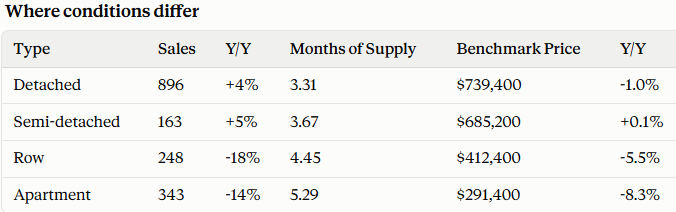
Detached: Sales were up from both August and last year, helped by more new listings. With a 52% sales-to-new-listings ratio and about 3.3 months of supply, the market is relatively balanced, though it varies by area. The North West, West and South have under three months of supply, while the North East has nearly six.

Semi-detached: Sales grew year over year, but listings grew faster, so months of supply moved up to 3.67. Prices were basically flat versus last year at $685,200.

Row: Sales eased and inventory is up, pushing supply above four months for the first time this year. Prices are down 5.5% from last year, with the steepest declines in the North East and East.

Apartment: Sales improved from August, but supply sits above five months, and prices are down 8.3% year over year. A big part of the story is the amount of new high-density construction that has come to market over the past few years, giving buyers more choice.

What about the districts?

Total residential benchmark prices by district:

  • West: $721,200 (+1.7%)

  • City Centre: $573,100 (+0.2%)

  • North West: $627,000 (-0.2%)

  • South: $569,500 (-0.3%)

  • South East: $553,700 (-1.6%)

  • North: $523,000 (-3.3%)

  • East: $390,600 (-4.7%)

  • North East: $461,200 (-6.1%)

The West and City Centre are the only districts showing year-over-year gains, while the North East, East and North show the biggest pullbacks, partly because of heavier supply and a higher share of row and apartment stock.

What this means for you

If you're buying: You have more choice than you did a year ago, especially in apartments and row homes, where days on market and supply are higher. Homes took an average of 44 days to sell, and they sold for about 97.4% of list price on average, so there's room to negotiate. Detached buyers in the North West, West and South should expect more competition.

If you're selling: Pricing correctly from day one matters more than it did earlier in the year. Detached and semi-detached sellers are in a stronger position, while row and apartment sellers should expect buyers to compare many alternatives and be realistic about pricing and presentation.

Looking ahead

Some price softening is normal as we move through fall, and the underlying picture is steady: a stronger job market and positive, if slower, migration are supporting demand. The key thing to watch is whether the late-year supply increase continues, particularly in semi-detached and row homes.

Thinking about buying or selling? Reach out for a free, no-pressure look at what these numbers mean in your neighbourhood.

Source: CREB® Monthly Statistics Package, City of Calgary, September 2026.

Ready to Navigate This Market With Confidence?

Whether you're buying, selling, or just trying to understand what these numbers mean for your specific neighbourhood, I'm here to help you cut through the noise and make your best move.

Looking for community info, market stats & schools:

Looking for a particular lifestyle:

Other Blogs:

Read

New property listed in West Bragg Creek, Bragg Creek

I have listed a new property at 16 Mountain View PARK in Bragg Creek. See details here

Imagine living in total tranquility away from the city and amongst nature. Mere minutes away from Bragg Creek and a short commute into Calgary, this country paradise may well be what you have been seeking. Sitting on 2 acres and surrounded by mature mixed forest and a beautifully landscaped yard space, this 2780 square foot multi level home has plenty of deck coverage and an oversized double detached garage. Completing the fully fenced yard is a greenhouse with water and power, a paver style outdoor area off the greenhouse, a fenced raised vegetable garden and a solid cedar privacy fence on the west side of the property. Seasonal water buried for the garden and greenhouse. Main level entry brings you into a massive family room with high vaulted ceilings inviting maximum natural lighting and plenty of options for functionality. Stairs lead you to the upper level, which has seen $80,000 in upgrades, including new windows. Primary bedroom includes vaulted ceilings, a walk-in closet, balcony, and luxurious 5 piece ensuite with heated flooring. Second bedroom also had its own full ensuite and walk-in closet. Completing the upper level are a completely renovated half bathroom and laundry room. Kitchen has plenty of cupboard space, granite countertops and stainless appliances and overlooks the living and dining room making it a perfect place for entertaining guests. It is truly the centerpiece of this area. The living room has seen a $10,000 upgrade to the fireplace. This is a great spot to curl up on the couch with a book after a long day. Hardwood flooring coverage dominates. Enjoy a morning coffee or evening glass of wine on the sprawling double tiered west facing deck. At 1439 square feet, the lower level has been fully remodeled. Recreation room is an ideal room for the big screen TV and pool table. Lower level also has 2 additional bedrooms with egress, a flex room/gym with egress, and a full bathroom. New drywall, flooring, closets, lighting, windows, hot water heater, water filtration, and sump pumps The basement renovation has seen $60,000 in quality and functionable upgrades. Please note this property was purchased privately in 2017 prior to significant improvements being implemented since that time. Located in a private neighbourhood just 2 km from downtown Bragg Creek, this home backs onto 100+ acres of undeveloped land. Water and septic are on a community utility serving 8 homes. The street itself connects directly to the West Bragg Creek Trails. You can literally bike or run along the path system to the West Bragg Creek Trails, which is just 5 km away. This opportunity provides the convenience of being close to Bragg Creek and Calgary yet giving you the peace and quiet of true country living. Come and truly experience everything this great property has to offer.

Thinking about selling your Calgary home? Contact Chris Marshall Calgary Realtor for a home evaluation and personalized advice about which improvements are worth making before you list.

About Chris Marshall  |  Chris Marshall is an Associate Broker and REALTOR with RE/MAX House of Real Estate, serving buyers and sellers across Calgary and surrounding communities. A Certified Condominium Specialist with over 23 years of Calgary market experience, Chris specializes in helping clients navigate all stages of their real estate journey. Visit chrismarshallrealtor.com or call 403 585 5362.

Community info, photos, other homes for sale: Bragg Creek

Looking for community info, market stats & schools:

Looking for a particular lifestyle:

Other Blogs:

Read
Categories:   Abbeydale, Calgary Real Estate | Acadia, Calgary Real Estate | adult living | Airdrie, Airdrie Real Estate | backyard | Beginner Golf Calgary | Beltline, Calgary Real Estate | Bonavista Downs, Calgary Real Estate | Bowness, Calgary Real Estate | Calgary Golf | calgary real estate | Calgary Real Estate Market | Cambrian Heights, Calgary Real Estate | Canyon Meadows, Calgary Real Estate | Carrington, Calgary Real Estate | Castleridge, Calgary Real Estate | Chaparral, Calgary Real Estate | Christie Park, Calgary Real Estate | Citadel, Calgary Real Estate | condo | Copperfield, Calgary Real Estate | Cranston, Calgary Real Estate | curb appeal | deck maintenance | Dog friendly backyard | Dover, Calgary Real Estate | Downtown East Village, Calgary Real Estate | Downtown West End, Calgary Real Estate | eco friendly | environment | exterior reno | garage door | garage door with windows | Golf for Kids in Calgary | Greenview, Calgary Real Estate | Haysboro, Calgary Real Estate | home buying | home decor | home maintenance | home office | home organization | Legacy, Calgary Real Estate | lung cancer | Mahogany, Calgary Real Estate | Marlborough Park, Calgary Real Estate | McKenzie Towne, Calgary Real Estate | Midnapore, Calgary Real Estate | Mini Golf in and around Calgary | modern garage door | Montgomery, Calgary Real Estate | Palliser, Calgary Real Estate | Panorama Hills, Calgary Real Estate | Par 3 Calgary Golf | Parkdale, Calgary Real Estate | Penbrooke Meadows, Calgary Real Estate | Pet friendly backyard | radon | real estate return on investment | Renfrew, Calgary Real Estate | retirement living | Rocky Ridge, Calgary Real Estate | senior living communities | Signal Hill, Calgary Real Estate | Southwood, Calgary Real Estate | Strathcona Park, Calgary Real Estate | Sunnyside, Calgary Real Estate | Things to do in Calgary | Thorncliffe, Calgary Real Estate | townhouse | Walden, Calgary Real Estate | West Bragg Creek, Bragg Creek Real Estate | Windsor Park, Calgary Real Estate | Woodbine, Calgary Real Estate | yard maintenance
Data is supplied by Pillar 9™ MLS® System. Pillar 9™ is the owner of the copyright in its MLS®System. Data is deemed reliable but is not guaranteed accurate by Pillar 9™.
The trademarks MLS®, Multiple Listing Service® and the associated logos are owned by The Canadian Real Estate Association (CREA) and identify the quality of services provided by real estate professionals who are members of CREA. Used under license.